
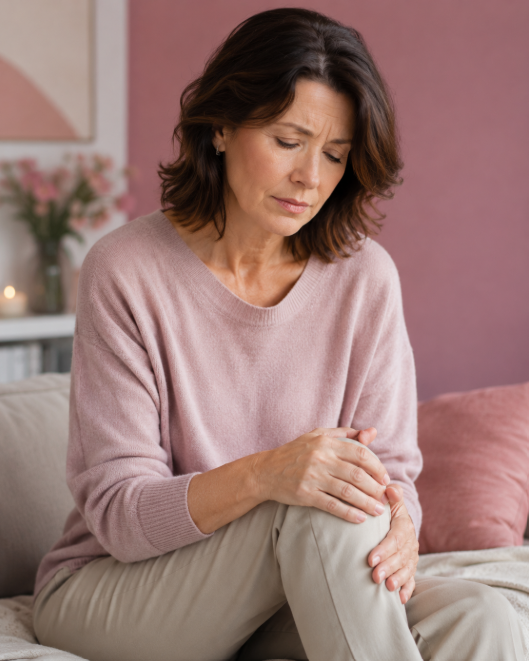
Joint & Muscle Pain: Why It Happens
If your knees, hips, shoulders, or hands started aching around the same time your periods changed, that's not a coincidence — and it's not "just getting older." Joint and muscle pain is one of the most common symptoms of menopause worldwide, affecting roughly two in three midlife women, and researchers have recently begun calling the cluster by its own name: the musculoskeletal syndrome of menopause.
Estrogen turns out to be quiet infrastructure for your entire frame. It supports cartilage health, keeps tendons and ligaments elastic, helps regulate inflammation, contributes to maintaining muscle, and even influences how your nervous system processes pain. As levels fall, many women notice a familiar package: morning stiffness that takes longer to loosen, achier joints after activity that never used to cost anything, slower recovery, and new tightness in places like the shoulders — frozen shoulder, notably, is far more common in midlife women.
Muscle is part of this story too. The transition accelerates natural muscle loss, and muscle is your joints' support system — less of it means more load lands on the joints themselves. That's one reason the aches and the "where did my strength go" feeling tend to arrive together.
One important boundary: not every ache belongs to menopause. A joint that's hot, swollen, or red; morning stiffness lasting over an hour; pain that wakes you at night; or one severe joint that stands out from the rest — those patterns deserve a medical evaluation, because inflammatory arthritis and other conditions need their own treatment.
For everything else, your own data is the starting point. Log pain alongside activity and sleep in KnowMeno and watch the pattern: which days flare, what preceded them, whether movement helps (it usually does). That record beats "everything hurts" in any doctor's office — and the next article covers the surprisingly powerful things you can do about it.